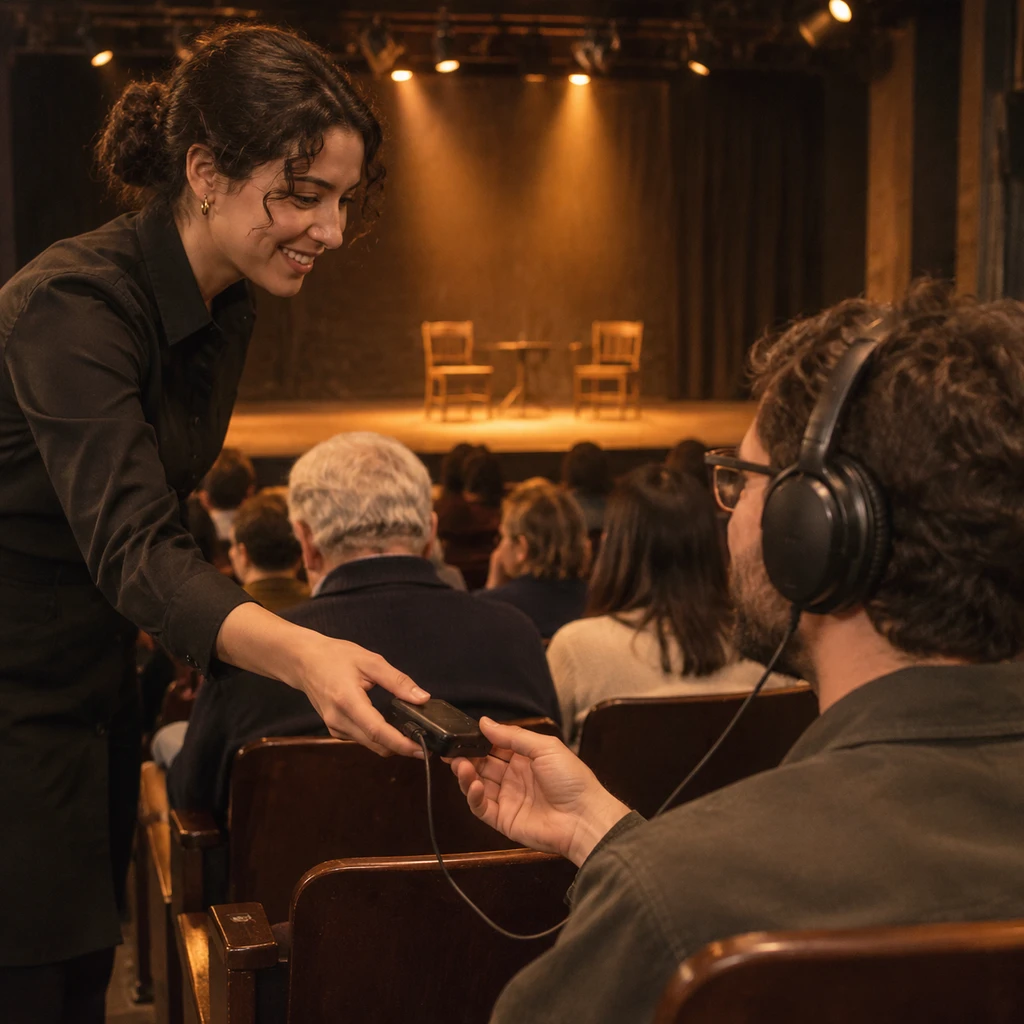
“演出快开始了,请打开耳机。”在纽约外百老汇的《Love Me》,这句提示关系到观众接下来怎么听戏。剧场用蓝牙广播 Auracast 承担主要传声,现场扬声器只负责部分声音提示。一旦耳边成了主要听音入口,找不到广播就可能错过开场。
这部独角戏由 Drew Michael 演出,2026 年 10 月 24 日至 11 月 22 日在纽约 SoHo Playhouse 的 178 座主舞台上演。声音设计师 Daniel Kluger 把 Michael 的听力损失写进听感里。据 The Verge 描述,有些段落刻意让扬声器里的声音发闷,耳机里的内心独白却始终清楚。
同一座剧场,三条声音路径
Listen Technologies 与 Ampetronic 的公告把现场分工说得很清楚。观众的主节目由 Auri 发射器广播。支持 Auracast 的助听器或人工耳蜗处理器可以直收;借用设备的观众拿到的是小型 Auri 接收器和 Austrian Audio 有线耳机。无线传输到接收器就结束了,进耳机的最后一段走线。
Kluger 仍用剧场扬声器播放部分声音提示。台上的 Michael 则用支持 Auracast 的助听器收听独立监听。观众听他的内心独白,他听自己的监听,两边各有一路信号。
<svg viewBox='0 0 720 320' width='100%' height='320' role='img' aria-label='演出音频分别送往观众、剧场扬声器和演员'>
<rect x='0.5' y='0.5' width='719' height='319' rx='16' fill='#fbf9f4' stroke='#e2dccf'/>
<text x='30' y='38' font-size='19' font-weight='700' fill='#b25a3a'>剧场的三条传声路径</text>
<line x1='30' y1='54' x2='690' y2='54' stroke='#e2dccf'/>
<polyline points='180,183 204,183 204,108 236,108' fill='none' stroke='#b25a3a' stroke-width='2'/>
<line x1='180' y1='183' x2='236' y2='183' stroke='#c4baac' stroke-width='2'/>
<polyline points='180,183 204,183 204,258 236,258' fill='none' stroke='#c4baac' stroke-width='2'/>
<polygon points='236,103 246,108 236,113' fill='#b25a3a'/>
<polygon points='236,178 246,183 236,188' fill='#c4baac'/>
<polygon points='236,253 246,258 236,263' fill='#c4baac'/>
<line x1='420' y1='108' x2='492' y2='108' stroke='#b25a3a' stroke-width='2'/>
<line x1='420' y1='183' x2='492' y2='183' stroke='#c4baac' stroke-width='2'/>
<line x1='420' y1='258' x2='492' y2='258' stroke='#c4baac' stroke-width='2'/>
<polygon points='492,103 502,108 492,113' fill='#b25a3a'/>
<polygon points='492,178 502,183 492,188' fill='#c4baac'/>
<polygon points='492,253 502,258 492,263' fill='#c4baac'/>
<rect x='30' y='155' width='150' height='56' rx='9' fill='#f3eee4' stroke='#e2dccf'/>
<rect x='246' y='80' width='174' height='56' rx='9' fill='#f7ede6' stroke='#b25a3a'/>
<rect x='246' y='155' width='174' height='56' rx='9' fill='#f3eee4' stroke='#e2dccf'/>
<rect x='246' y='230' width='174' height='56' rx='9' fill='#f3eee4' stroke='#e2dccf'/>
<rect x='502' y='80' width='188' height='56' rx='9' fill='#f7ede6' stroke='#b25a3a'/>
<rect x='502' y='155' width='188' height='56' rx='9' fill='#f3eee4' stroke='#e2dccf'/>
<rect x='502' y='230' width='188' height='56' rx='9' fill='#f3eee4' stroke='#e2dccf'/>
<text x='105' y='189' text-anchor='middle' font-size='17' fill='#2c2822'>演出音频</text>
<text x='333' y='114' text-anchor='middle' font-size='17' font-weight='700' fill='#b25a3a'>Auri 主节目广播</text>
<text x='333' y='189' text-anchor='middle' font-size='17' fill='#2c2822'>剧场扬声器</text>
<text x='333' y='264' text-anchor='middle' font-size='17' fill='#2c2822'>独立监听</text>
<text x='596' y='103' text-anchor='middle' font-size='15' fill='#2c2822'>兼容设备直收</text>
<text x='596' y='123' text-anchor='middle' font-size='14' fill='#7a7266'>借用接收器加耳机</text>
<text x='596' y='189' text-anchor='middle' font-size='17' fill='#2c2822'>部分现场提示</text>
<text x='596' y='264' text-anchor='middle' font-size='17' fill='#2c2822'>演员助听器</text>
</svg>
耳机里有声,戏也可能少一截
英国听力慈善机构 RNID 采访过一位叫 Gideon 的观众。Auracast 曾帮他听清原本听不清的台词,他也遇到过重连困难。另一次看音乐剧,他接上了广播,却只听到人声,没听到音乐。这些经历来自其他剧场,但正好说明两种故障该找不同的人。连不上要查设备、选台和覆盖,漏了配乐要查广播混音。
还有一种情况,两边都有声,同一个声音却先后到耳朵,听起来像回声。这得测整条链路的时差。蓝牙技术联盟要求接收器支持 40 毫秒的呈现延迟,现场端到端延迟还要实测。联盟举的约 100 米也是公共发射器的示意距离。它给场馆的布设指引更实在,沿观众区走测,有观众时再测一遍。
<svg viewBox='0 0 720 310' width='100%' height='310' role='img' aria-label='听音故障分为接入、混音和同步问题'>
<rect x='0.5' y='0.5' width='719' height='309' rx='16' fill='#fbf9f4' stroke='#e2dccf'/>
<text x='30' y='38' font-size='19' font-weight='700' fill='#b25a3a'>按听到的现象排查</text>
<line x1='30' y1='54' x2='690' y2='54' stroke='#e2dccf'/>
<rect x='30' y='82' width='660' height='58' rx='9' fill='#f3eee4' stroke='#e2dccf'/>
<rect x='30' y='153' width='660' height='58' rx='9' fill='#f3eee4' stroke='#e2dccf'/>
<rect x='30' y='224' width='660' height='58' rx='9' fill='#f3eee4' stroke='#e2dccf'/>
<line x1='192' y1='98' x2='192' y2='124' stroke='#e2dccf'/>
<line x1='192' y1='169' x2='192' y2='195' stroke='#e2dccf'/>
<line x1='192' y1='240' x2='192' y2='266' stroke='#e2dccf'/>
<text x='54' y='117' font-size='17' font-weight='700' fill='#2c2822'>接入</text>
<text x='54' y='188' font-size='17' font-weight='700' fill='#2c2822'>混音</text>
<text x='54' y='259' font-size='17' font-weight='700' fill='#2c2822'>同步</text>
<text x='224' y='117' font-size='17' fill='#2c2822'>搜不到或掉线</text>
<text x='224' y='188' font-size='17' fill='#2c2822'>只听见台词</text>
<text x='224' y='259' font-size='17' fill='#2c2822'>同一声音听两遍</text>
<text x='478' y='117' font-size='15' fill='#7a7266'>查设备与覆盖</text>
<text x='478' y='188' font-size='15' fill='#7a7266'>查广播节目流</text>
<text x='478' y='259' font-size='15' fill='#7a7266'>测全链路时差</text>
</svg>
从入场到听清,中间还有前台
Auracast 用蓝牙 LE Audio 做一对多广播,无需逐台配对。但能否直收要查具体型号和固件,蓝牙版本或 LE Audio 标签给不了答案。联盟建议公共场所提供标准质量流,因为部分助听器收不到高质量流。剧场只开高质量流,反而可能让本想省去借机的观众多排一次队。
借机也有自己的门槛。RNID 采访的 Nicola 用颈环感觉不错,另有剧场的耳罩却太紧,戴着助听器就罩不舒服。对前台而言,配件和备机跟发射器一样实际。观众进场才发现设备接不上,工作人员得赶在开演前换一条能用的听音路径。
加装容易论证,拆旧要看满场
从感应环路到射频、红外,剧场早就有把声音直接送到观众耳边的办法。以往这些系统多给扬声器补位,《Love Me》把个人接收设备推到了主位。对有感应线圈的观众,覆盖良好的环路仍可能更省事。射频接收不依赖光学通路,红外则更怕遮挡。哪套好用,要看观众坐下后要做多少事才能听清。
伊利诺伊州的 Marriott Theatre 选择保留环路,再增设 Auracast。受 ReSound 邀请参加上线活动的观众说台词或歌词更清楚。这些反馈来自现场体验,无法判定换掉环路后,原来的观众还能不能一样顺利地听戏。
我更愿意把《Love Me》看成一次声音设计上的成功尝试。它用耳边的清晰独白和外界的模糊声讲同一个人的故事。至于其他剧场能不能照搬,现有披露还缺《Love Me》的满场分座区测试、实际端到端延迟和借机数量,也缺直连与借机观众各自的反馈。剧场真要让耳机担纲,开演前那句提示就得有个可兑现的承诺。接不上的观众,也赶得上第一句台词。